The farmer was soon to die; there was no doubt about it. Indeed, his sons knew it, the townspeople knew it, and he himself knew that neither the town doctor nor the prayers of the people could prevent the event from coming about. I, for one, know not what sort of ailment assailed him, but along with others, know that it was beyond human aid. To lay in bed, his eyes yellow and his hands shriveled, was all he could do: wherefore he called his five sons to the deathbed, being eager to impart a secret to them. The five of them, being of tall stature and little grace, clambered up the stairs with a noise like that of an elephant: and gathered round their father with nostril hairs bristling, feet shuffling, eyes bulging, and necks craning. The farmer cleared his throat, opened his yellow eyes, and spoke: “My sons—death is upon me—my body if frail and weak from years of cursing the vineyard and the fruit it bears and bringing up by hand five ignorant, lazy imbeciles, and I have yet one sole thing to impart to yourselves.” The five sons, each of them equally lazy, slovenly, niggardly, gluttonous, and greedy, nodded in unison. Snorted the father, and he continued: “in your lives, you have been fortunate to have me, a rich and prosperous farmer, as your father. A treasure I have, a small fortune of my own making. Search underneath the vineyard, and you will find it.” The five sons, having no patience for their father’s death, all rushed out of the house with spades and shovels, despicably neglecting the dying farmer. So eager were they to find the treasure, these five dastardly men, that they dug for days and days until at last, when no treasure miraculously appeared, they retired to their beds. As no such thing existed, their efforts were in vain—but through their incessant digging, the ground of the vineyard became fertile and from it came a crop such as Dr. Hayes, Reverend John, the grocer, and the bartender swore they had never before seen.
To some degree, the idea of being stranded on a desert island truly appeals to me. While some people might die of boredom or loneliness, I would enjoy the privacy, solitude, and peace that a few months alone on an island would provide me with. However, I am not ignorant of the many challenges I would face during that time. In addition to the potential issues of boredom and loneliness, there are also the dangers of getting injured or becoming ill.
Something I would want to find washed up onto the island’s shore that would be infinitely useful to me would be a healing ointment. This healing ointment is not just any average healing ointment, and if truth be told, it does not even qualify as an ointment. Rather, it is a cordial of some mystical kind—“made of the juice of one of the fire-flowers that grow in the mountains of the sun (Lewis 109)”. I imagine that I would find it sticking out of the beach one day, its bottle, which some say is made of diamonds, protruding out of the sand and shimmering as the sun reflects off of its dazzlingly bright surface. Rather than wonder how on earth it managed to make its way from Narnia to my island, I would immediately lunge for it, wrap my fingers around it, and thank the Lord for its arrival. Mythical origins aside, the cordial possesses medicinal properties that few modern medicines can hope to achieve. A single drop has the ability to cure a mosquito bite, a dreadful fever, or an intense migraine. What better antidote could I ask for while stranded in such a hostile environment?
Useful as it is, a healing cordial would not be the entire solution to the existing physical dangers. After all, who knows whether or not the island is filled with animals and creatures who do not have my best interests in mind? Somehow, I must defend myself. To fulfill this need, the second thing that is washed up onto the island’s shore is Artemis’ bow and a quiver of arrows. Artemis’ silver arrows, though deadly and accurate, do not cause pain upon contact (D’aulaire 46). If I was ever forced to kill an animal that had attacked me on the island, I would at least be able to spare it from some amount of pain. It would be my utmost desire to not have to take the life of any creature during my short visit; nevertheless, one must be prepared to defend oneself in the event of an unexpected attack.
Although I like to think that I would not be plagued by boredom during my stay on the island, I must admit that I would desire some form of entertainment to pass the time. Thus, the last thing that is washed up onto the island is a book of fairy tales. This book, fashioned by a fairy herself—not my fairy godmother, but that of the princess of Kyrria—contains stories that are ever-changing (Levine 56). I might open it one day to discover a plethora of delightful tales concerning elves, dwarves, or ogres, and I might open it the next day to a journal entry penned by my sister, with a corresponding picture of what my family might be doing that same day. A collection of stories, pictures, and letters such as this would satiate my hunger for entertainment and would also give me the satisfaction of being able to see my family and, in a sense, be with them.
The disadvantages of being stranded on a desert island are many, but there are three items that I believe would solve many of them. The cordial given to Lucy Pevensie of Narnia would heal me of any illnesses or injuries; Artemis’ arrows, forged especially for her by the Cyclopses, I could use to protect myself in times of danger; and a magical collection of tales, true or fictional, would both comfort and amuse me. These objects would satisfy a large portion of my physical and emotional needs, and those are two needs that are necessary to meet while in the isolated, lonely environment of a desert island.
Bibliography
Lewis, C S, and Pauline Baynes. The Lion, the Witch, and the Wardrobe. New York, HarperTrophy, 2008.
Ingri D’aulaire, and Edgar Parin D’aulaire. Ingri and Edgar Parin d’Aulaire’s Book of Greek Myths. New York, Bantam Doubleday Dell, 2003.
Gail Carson Levine. Ella Enchanted. New York, Harper, An Imprint Of HarperCollins Publishers, 2017.
for KING & COUNTRY’s version of the classic Christmas song, Little Drummer Boy, is by far my favorite rendition of the song.
It’s difficult to explain why I love this particular version so much. The music itself is beautiful—the song begins with the infectious drum intro and the vocals are strong and filled with real conviction—but it is some of the new alterations and lyrics that are added to this version that never fail to speak to my very soul.
I’ve discovered that whenever I listen to that song, I always find myself waiting in anticipation for the very last part of the song. The singer sings me and my drum right at three minutes twenty-seven seconds, when the music stops for exactly two seconds and one expects the entire piece to reach an end. But it begins again with the dramatic entrance of stringed instruments playing in harmony for eighteen seconds, and then the me and my drums begin again, each one more stronger and more triumphant than the last. And then the lyric that always, always breaks me enters: All I can give. It’s repeated three times. What I love most about it isn’t the truth of the statement but the tone it’s uttered in: it’s not sung in a way that makes giving our “drums” to God seem a burden, or something that breaks our spirit. The line is delivered in a tone that is exuberant, overjoyed, and absolutely enraptured. It encapsulates the real spirit of being able to give ourselves and any gift or lack thereof that we have to Him—and that the ability of being able to do so is truly a beautiful blessing. It couldn’t make me feel any more ecstatic, that I am able to give everything I have to Him. He doesn’t necessarily need the gifts I have. I would be in possession of unfathomable arrogance to presume that the Lord is in desperate need of anything I have. I give Him all I can give, just as the song says, so to honor Him. The first half of the song captures the beauty of being able to play for Him: Shall I play for You? the singer asks. Mary nodded… the ox and lamb kept time… I played my drum for Him… I played my best for Him. The emphasis on best is beautiful, for Christ is deserving of all we can give and the very best we give. And when the singer finally sings quietly, “then, He smiled at me”? Picture me, bursting into tears internally. Oh, joy upon higher joy. To be able to play for Him, to play whatever we can and to play it the best we can, is that one joy that I can never get over. Most of all, I can’t wait to see Jesus smile at me. I would be brought to my knees in tears of pure joy.
A disclaimer: I am a huge Chosen fan, and I have never claimed anything otherwise. I just want to make it clear that this article will be very biased as it comes from a person who has been following the show since late 2020, fanatically raves about it constantly, and tries to convince everyone on earth that it’s worth watching.
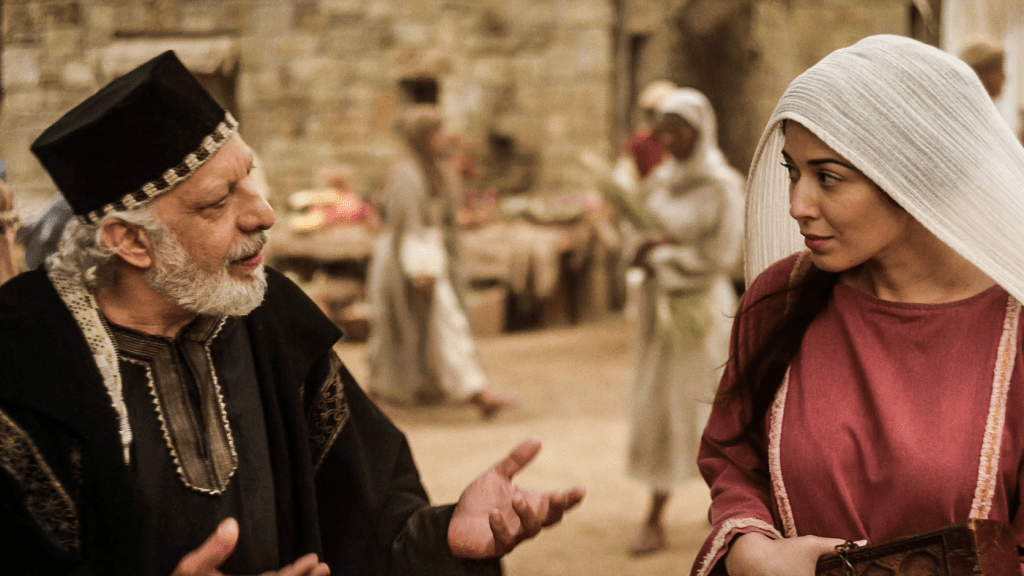
Mary Magdalene and Nicodemus; Season One
Unless you’ve been living under a rock for the past two years, you’ve probably heard of the hit television show The Chosen. You may have heard about it through a church going friend. Or perhaps you read about it in the news. Or maybe a certain YouTube thumbnail caught your eye while you scrolled down your FYP.
In simple words, The Chosen is a Jesus show. It revolves around the life and doings of Jesus Christ and his relationships with those whose lives he touched. The description sounds fairly stereotypical, at least for a Christian television show, but there seems to be something about the show that sets it apart. It has garnered so much critical praise and attention from people even outside the evangelical Christian community—atheists, agnostics, and dozens of different denominations all flock to the internet to rave about how entertaining the show is, how it impacted them, etc. etc. So what exactly makes this show a good television show?
Storytelling
The Chosen takes visual storytelling to an entirely different level. The characters portrayed by deeply dedicated, gifted actors are drawn well; they are actual people who have believable problems, emotions, and character nuances. Growing, maturing, and changing in a noticeable yet gradual development arc, each and every character tells a different story that is both spiritually and emotionally charged. Most importantly, they are people we can all relate to, whether or not we have read the Bible or even the Gospels before. The characters are, of course, only one aspect of the intricate storytelling The Chosen wields. It seems that a lot of television shows or movies in today’s day and age entertain plots that seem strong during the beginning but are gradually revealed to be floundering in inconsistency, confusion, and a lot of superfluous sub-plots. The Chosen is by no means perfect in its efforts to be intentional and detail-oriented, but it does achieve a remarkable number of scenes that are all essential to the storyline and character development. They don’t throw in sub-plot after sub-sub-plot “just because”. That being said, The Chosen is still a drama, so you can expect a lot of detailed plots and character storylines to take up the bulk of the show.
Production
The Chosen began in 2017. The franchise is entirely crowdfunded, which is quite impressive considering the amount of success it has achieved outside of its own target audience. Thus, one would think that the narrow budget and the lack of funds would cause the show’s production to be rather shoddy and poorly done. It is true that there are certain scenes in the first season that have shaky, almost unprofessional shots; however, these are in the minority. The Chosen, despite their miniscule budget and slim amount of funds, has somehow, miraculously, managed to shoot some of the most beautiful, well-directed scenes I’ve seen in my short life. In the second season, they even achieved a fifteen-minute one-shot, a phenomenon rarely seen in cinema. In line with the story’s background and location, the Chosen is shot on several different sets that are dynamic, realistic, and beautiful. If anything, the production appeals to the senses—there is a constant overflow of rich colors, cacophonous crowd noises and animal noises, and aesthetically pleasing scenery.
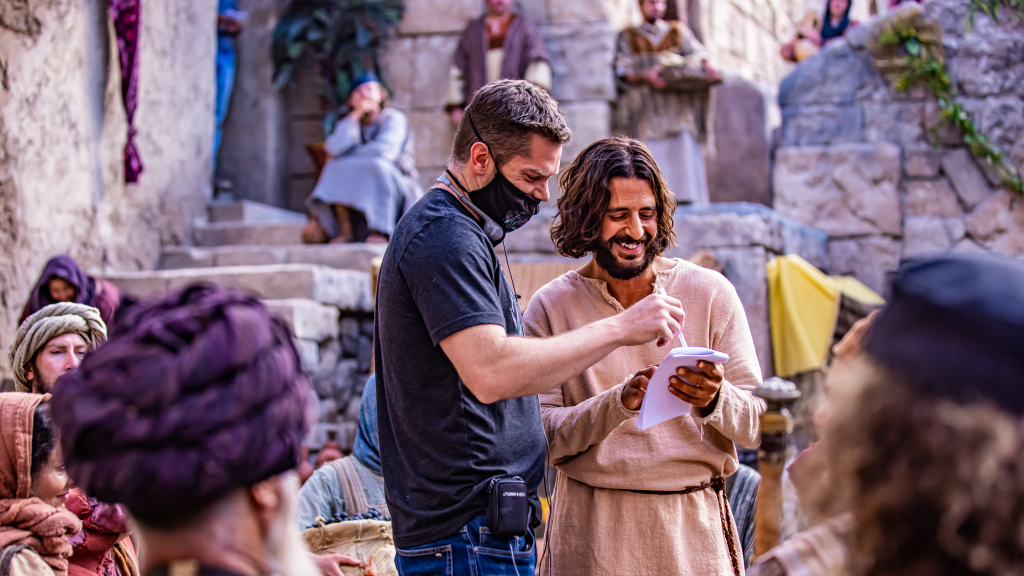
Behind the scenes of Season Two with Dallas Jenkins, director (left), and Jonathan Roumie, who plays Jesus
Acting
Acting seems to be a rampant problem among Christian media projects. There seems to be a pattern among faith-based projects where the concept is alright, the storyline is okay if a bit poorly drawn, but the stilted, painfully awkward acting just seems to turn off the viewer immediately. I was a bit thrown by the polished, on-point acting when I first started watching the show. Since I usually have an aversion to Christian entertainment—I appreciate the effort, but the result sometimes is just excruciating to have to watch—it was a bit disconcerting to actually be enjoying the acting and marveling at the obvious passion of the actors. They aren’t just reciting lines with some forced emotion in their voices, they are actually telling the story as if it was their story. They have the passion, the dedication, and the talent to be able to do justice to each character in an individual manner. Obviously, like all shows, there are moments of poor acting that appear every now and then, but it can be said that for the majority of the show, the acting is very well-done and believable—not only that, it is also emotionally charged and moving.
Marketing
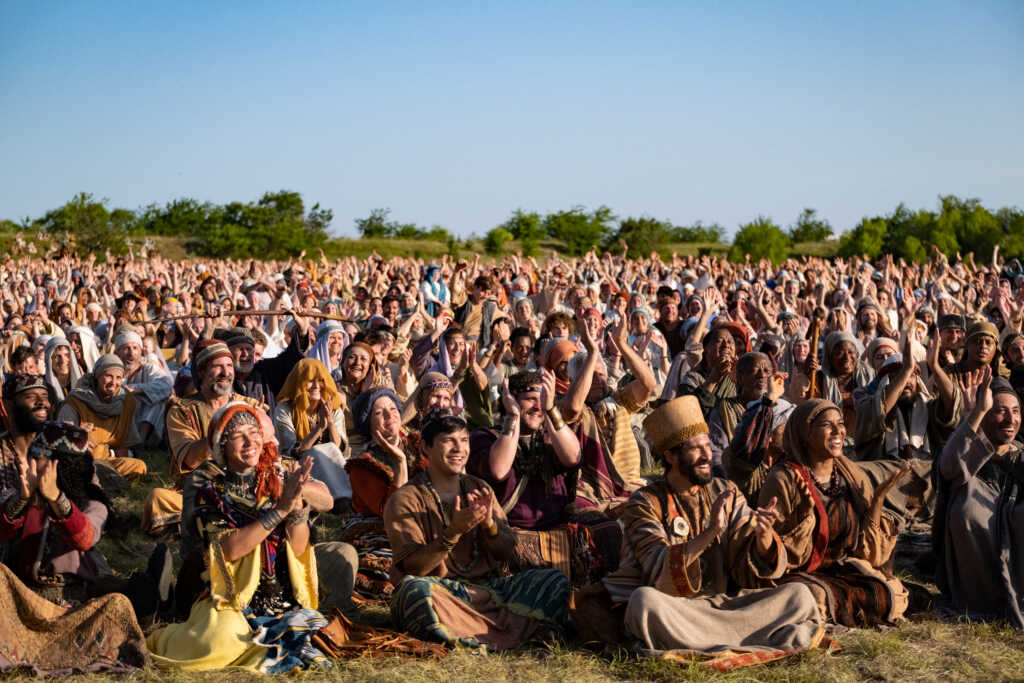
It is widely known that a major key to gaining more views and thus becoming more mainstream is good marketing. Sure, you might be able to make a good show, but if no one watches it, then it’s never going to get out there. And as fans of artists and projects such as Swifties and Potterheads have proved, a large, diverse, passionate and perhaps slightly crazy fan base attracts a substantial amount of media attention. The Chosen has managed to achieve that fan base through extremely personal fan interactions, events, and communication. It is crowd-funded, after all. The Chosen’s YouTube channel is home to livestreams that feature the director himself (Dallas Jenkins) talking to the fans themselves, behind the scenes videos, and interviews with all the cast members. Calling themselves part of “The Chosen Family” or “The Chosen Army”, many people who watch the show end up having such a good relationship with the show that they will do practically anything to support it and help it grow. For both Season Two and Season Three, the Chosen hosted thousands of their fans on set as extras during the filming of the Feeding of the Five Thousand and the Sermon on the Mount, two scenes that require large crowds. The saying “Just because it’s popular, doesn’t mean it’s bad” applies to this situation and gives you all the more reason to watch it.
Filming of the Feeding of the Five Thousand
The Message
The message of the Chosen is wholesome, meaningful, and—bonus—family-friendly. You don’t have to be a Christian to enjoy the show, and you don’t even have to know anything about the Bible to understand it. It presents the Gospels in relatable ways, focusing on the relationships Jesus had with actual people, which makes it both entertaining and relatable.
Conclusion
I would like to stress that I am by no means trying to force you to watch The Chosen. Whether or not you watch it is entirely up to you. I would say, though, to not judge the show based on the fact that it is faith-based and that it revolves around Jesus and his followers, and I would also like to emphasize that the only thing I am trying to convey through the contents of this article is that the Chosen is a good show, and that, if you are still on the fence about watching it, it really wouldn’t hurt to give Season One, Episode One, a try. So, if you have the time, go to their website, where you can watch all of Season One and Two (for free!). If you like it, awesome! I’m happy, you’re happy, and The Chosen is probably extremely happy as well. And if you don’t? Then by all means carry on with life—you only wasted fifty minutes of your life, which I’m sure won’t have any adverse affects on you in the long-run.
Season Three out now on streaming platforms including Amazon Prime, Roku, and Netflix